You were recently asked to take part in a survey on the state of the industry 10 years after the 2008 financial crisis. Thanks to your participation, we are better informed about your issues, your perspective on the economy and on our profession.
The data revealed by this survey enables us, among other things, to highlight your expertise in the business world.
Many thanks to everyone who contributed to the survey.
In fact, the results published in this press release were picked up by certain media, including La Presse + on September 16, 2018.
RISK MANAGEMENT AND STOCK SELECTION HAVE GREATLY IMPROVED
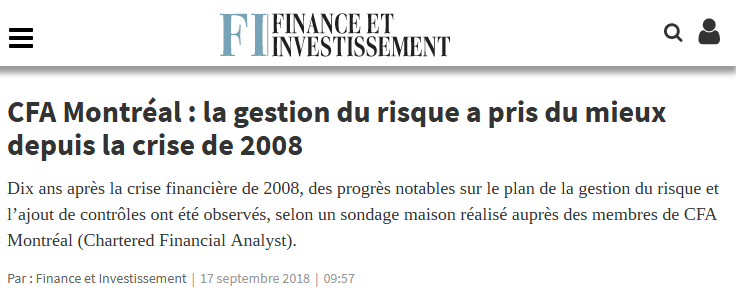
Ten years after the 2008 financial crisis, an in-house survey of CFA Montréal members (Chartered Financial Analyst) reveals significant progress in risk management, the addition of controls and improved due diligence in stock selection. The survey also shows that portfolio managers are demonstrating greater transparency and accountability.
"The survey results confirm that the investment industry has learned from the 2008 financial crisis, the most significant in the past 90 years," said Frederick Chenel, CFA, President of CFA Montreal. "Over 80% of respondents see significant improvements in both risk management and client relationships. In their view, a significant increase in regulation over the past ten years has also provided a better framework for the financial and investment industry, reducing the risk of such an episode recurring on the same scale in the future."
"A vast majority of respondents see a greater sense of accountability on the part of portfolio managers, and this vigilance on the part of industry professionals is in itself evidence of their efforts to safeguard the best interests of their investor clients," concluded Frederick Chenel.
The survey, to which some 10 % of CFA Montréal's 2,500 members responded, shows that investors' level of concern about the current economy remains relatively modest for 57% of respondents, and less than half of respondents envisage the possibility of falling back into another financial crisis by 2021. For 49% of them, the main triggers for another crisis would be political instability and uncertainty, and the waning of the bull market of the last ten years.
In the short term, CFA Montréal members rate emerging market debt and equities (59%), high-yield bonds (48%) and U.S. equities (38%) as the most risky investment types over the next twelve months.
Survey highlights
The survey was conducted online by CFA Montreal among its 2,500 members between August 20 and September 6, 2018, and 227 members completed the survey. The maximum margin of error is 6%, 19 times out of 20.
In the wake of the survey, CFA Montreal will be presenting a conference on September 18 entitled : 10 years on: The evolution of the asset management industry since the financial crisis.
The event is hosted by Monique Leroux, Chairman of the Board of Directors of Investissement Québec, corporate director and former President and CEO of the Desjardins Group, and features a panel of industry experts.